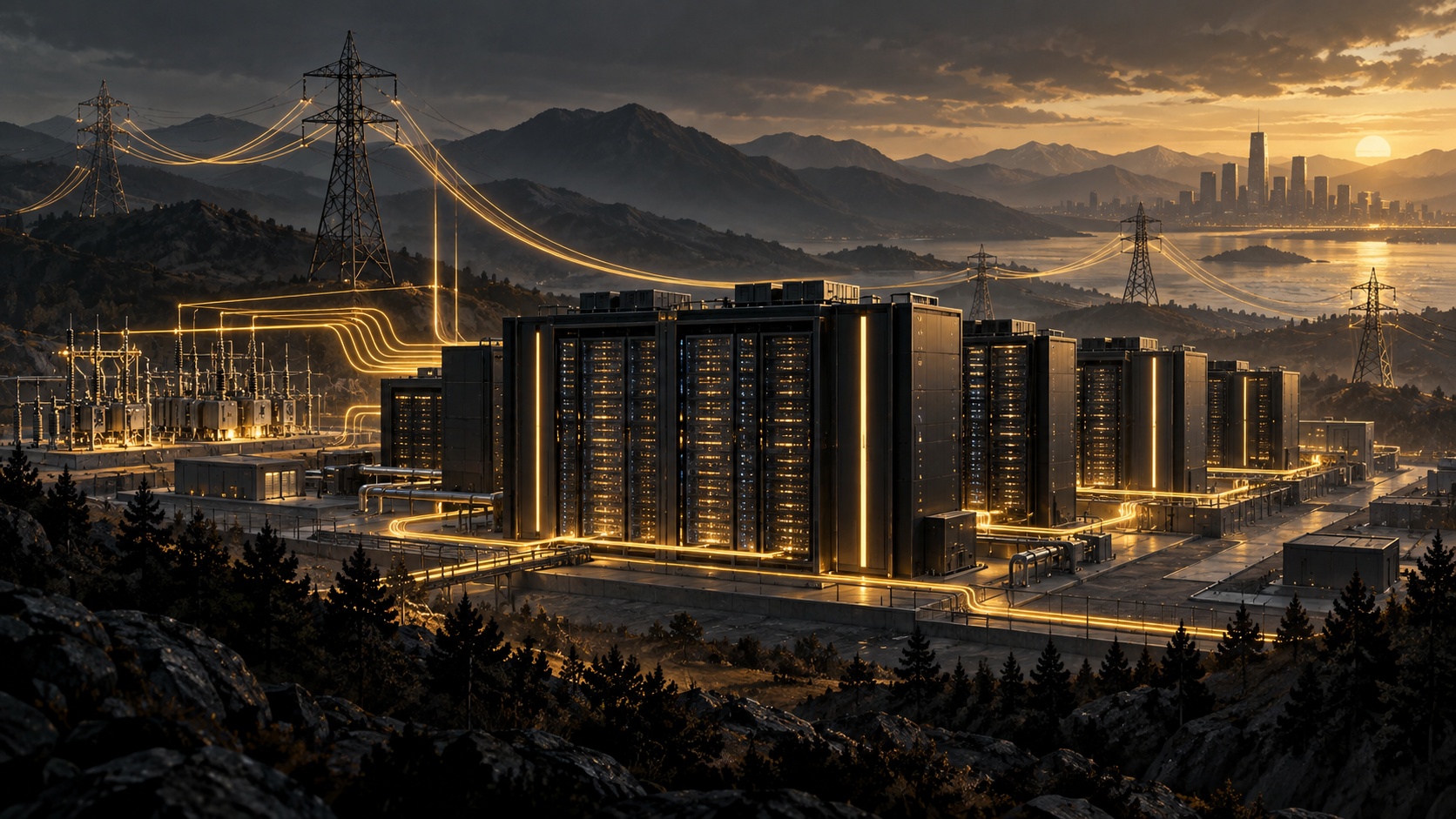
AI’s Power Problem: Why Electricity Is Becoming an Investment Story
A data centre can have a convincing business plan and customers waiting for capacity, yet still face a basic obstacle: getting enough reliable electricity to open on schedule. For anyone following the AI boom, the power connection deserves as much attention as the server order.
That changes how the story should be read. A large spending announcement tells us what a company intends to build. It does not, by itself, tell us when that investment will become a working business.
A global boom meets local limits
The International Energy Agency’s April 2026 outlook projects that electricity consumption across all data centres will rise from 485 terawatt-hours in 2025 to around 950 in 2030. AI-focused facilities are expected to triple their consumption over the same period. These are projections, not guaranteed outcomes; the wider total also includes data centres serving activities beyond AI. Read the IEA outlook.
The IEA also identifies a gap between investment ambitions and delivery: equipment shortages, connection approvals and other constraints are limiting the fastest near-term growth scenarios. A strong global demand forecast therefore cannot establish that a particular site has power available on the date its developer needs it.
The overlooked equipment problem
Reuters reported in July that delivery times for some high-voltage transformers had stretched to several years. Citing Wood Mackenzie, it put lead times for generator step-up transformers above 160 weeks in the first quarter of 2026. That figure applies to a specific equipment category, not every transformer or every grid connection. Reuters reporting, 9 July 2026.
Utilities and developers have responded with earlier orders, advance payments and a broader supplier base. These measures may protect a construction schedule, but they also raise a commercial question: how much money must be committed before a project begins earning revenue?
A place in the queue is not a finished project
There is a second complication: headline demand can include competing applications for projects that will never all be built. In September, Reuters found that very large electricity users, mostly data centres, had requested more than 700 gigawatts across parts of the US Midwest, Mid-Atlantic and South. These were requests, not operating capacity or a forecast of actual consumption. Reuters analysis, 1 September 2026.
Reuters also reported that Exelon reduced its estimate of high-probability data-centre demand by about 40%, to 11 gigawatts, after introducing tighter collateral requirements. That does not mean the AI boom has disappeared. It shows why financially committed demand deserves more weight than a list of proposals.
What this means for investors
Our view is that the useful question is no longer simply, “How much AI capacity is being announced?” It is, “What evidence shows this capacity can open, serve paying customers and earn an adequate return?”
Four checks help make that distinction. Is the customer commitment binding? Does the electricity connection have an achievable date and clear conditions? Has essential equipment been ordered? And who absorbs the cost if the timetable slips?
Consider two hypothetical projects with the same advertised capacity. One has committed customers and confirmed equipment deliveries. The other has an ambitious opening date but unresolved power arrangements. Treating them as equivalent would hide a major difference in execution risk.
The same discipline applies to companies supplying the buildout. An expanding order book is encouraging, but investors still need to examine margins, delivery commitments, cancellations and the price already reflected in the shares. A growing market is not a guarantee of an attractive investment.
AI remains a technology story. Understanding its economics now also requires following the electricity infrastructure that lets the technology work.
Morval Universal analysis | 11 September 2026. Cover: AI-generated conceptual illustration, not a photograph of a real facility. This article provides general information, not a recommendation to buy or sell an investment.