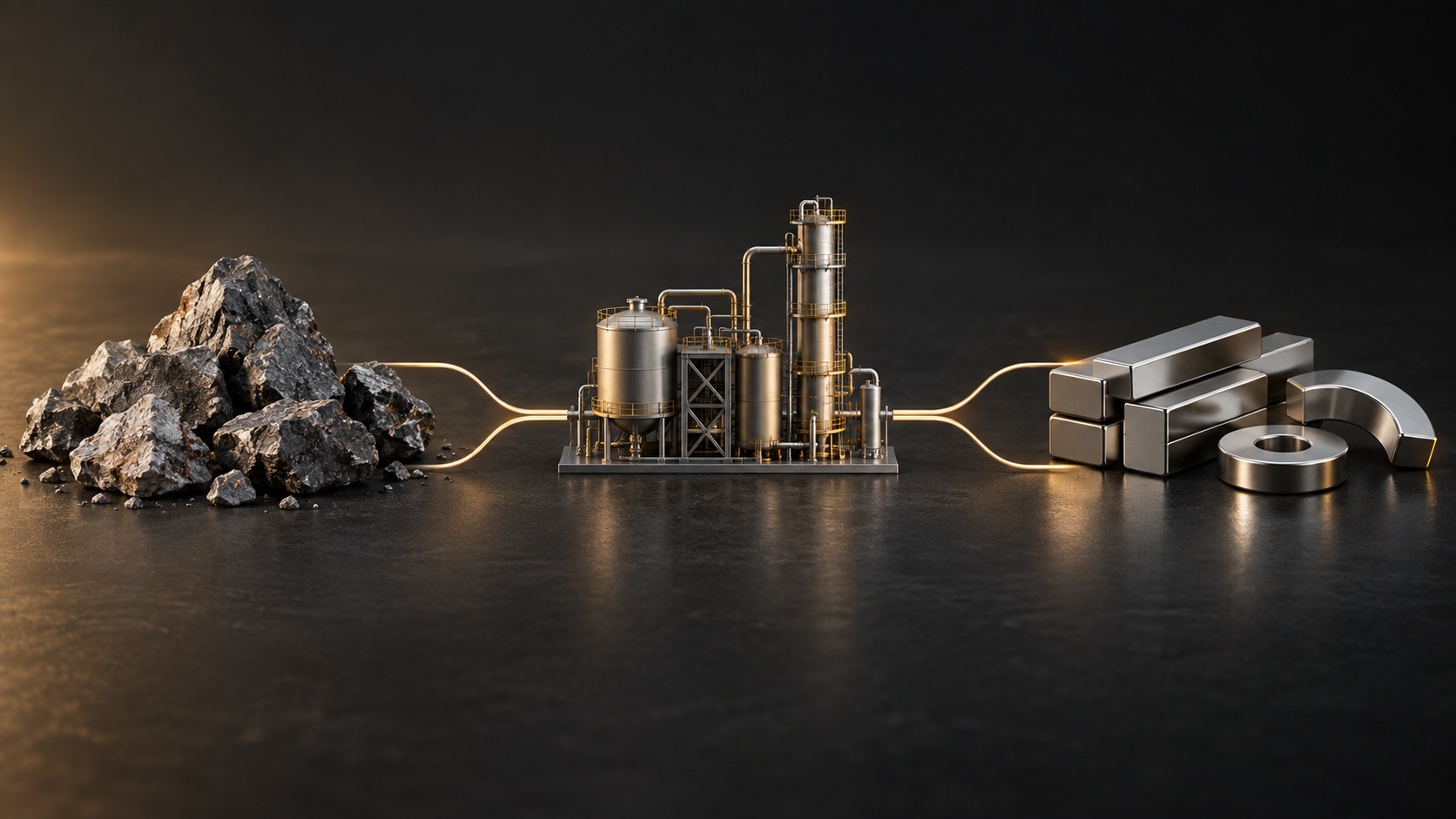
Rare Earths: Why More Mines Alone Won’t Fix the Supply Chain
A new rare-earth mine can make headlines long before a manufacturer can use anything it produces. Between the deposit and the finished motor sit several specialist industries. That is why reducing dependence on China involves more than digging additional ore.
The issue is back on the diplomatic agenda. Reuters reported on 20 September that critical minerals were among the subjects scheduled for US–China trade talks in New York. But negotiating access to existing supplies and building alternative supply chains are different tasks. Reuters reporting.
A mineral deposit is not a finished component
Rare earths are a group of 17 elements, some of which are used in powerful permanent magnets for electric vehicles, wind turbines and industrial motors. Mining is only the first stage. Material must be concentrated and separated, converted into metals and alloys, and manufactured into magnets that meet the intended application’s requirements. IEA supply-chain overview.
A manufacturer cannot replace a shipment of finished magnets with a shipment of ore. If processing capacity is missing, opening another mine does not close that gap.
The imbalance extends beyond mining
In its 16 July 2026 release, the International Energy Agency estimated that China’s share of rare-earth refining had fallen to 85% in 2025, from more than 90% in 2023. That is evidence of progress, not the disappearance of concentration risk.
The same release identified an imbalance in projects outside the dominant supplier: by 2035, planned refining capacity would cover roughly two-thirds of expected mine output, while planned magnet production would cover only one-third. These are 2035 projections incorporating existing capacity and announced projects, not measurements of current output. IEA’s July 2026 assessment.
A factory opening is not the finish line
Equipment has to work consistently, and customers have to accept the product. Reuters reported in July that MP Materials had spent years calibrating its separation equipment. The report illustrates why funding a project and making it commercially useful are separate milestones. Reuters, 27 July 2026.
There are tangible advances. On 14 September, Neo Performance Materials said its Estonia plant had delivered initial commercial volumes of magnets to an electric-vehicle motor customer after development, sampling and automotive qualification.
Neo described the initial phase as having approximately 2,000 tonnes of annual nameplate capacity. That means designed capacity; it is not a claim that the plant has already produced 2,000 tonnes. The distinction matters when assessing how much new supply is actually reaching buyers. Neo’s company announcement.
What a meaningful supply-chain announcement should tell you
For investors and business leaders, the useful questions are practical. Which stage does the project add: mining, separation, metal conversion or magnets? Is the quoted figure a target, installed capacity or actual output? Has a customer approved the product, and are commercial deliveries under way?
The IEA also highlights a financing dilemma: new suppliers need long-term purchase commitments, while buyers want proof that suppliers can deliver. Building a reliable alternative therefore requires customers and industrial expertise alongside capital. IEA analysis.
Morval’s takeaway: judge progress by the missing link a project fills and the usable products it delivers—not simply by the size of a deposit or an investment announcement. More mines can help. They are not, by themselves, a complete supply chain.
Morval Universal analysis | 20 September 2026. General information, not a recommendation to buy or sell an investment.
Cover: AI-generated conceptual illustration of a mine-to-magnet supply chain, not a photograph of an actual facility.